
The Dutch ICH Surgery Trial (NCT05460793) is a multicenter phase III, prospective, randomized, open, blinded endpoint (PROBE) clinical trial. Patients will be recruited in 11 neurosurgical centers in the Netherlands. In addition, local investigators in ~33 general hospitals without facilities for intracranial neurosurgery but with experience in clinical trials in stroke, will be part of the study group and refer patients for inclusion. The study will run for 4 years, which includes a 3-year inclusion period with a follow-up period of 12 months.
We will include 600 patients with a spontaneous, supratentorial intracerebral hemorrhage of 18 years and older with a minimal hematoma volume of 10 mL and a NIHSS of 2 or higher.
Patients with an aneurysm, arteriovenous malformation, dural arteriovenous fistula, or cerebral
venous sinus thrombosis as cause of their ICH will be excluded based on the admission CT
angiography. Patients with a known tumor or cavernoma will also be excluded.
For the DIST-INFLAME substudy, we will include 200 patients; 100 randomized to intervention and 100 randomized to standard medical management.
Minimally invasive endoscopy-guided surgery within 8 hours of symptom onset, in addition to standard medical management. The investigational product is: a device for minimally invasive, endoscopy-guided hematoma removal. Currently, the second generation Penumbra device, the Artemis system, is available and CE approved. When other devices will become available, they may be used when they are CE approved and deemed admissible by the steering committee.
The primary outcome parameter will be the modified Rankin scale (mRS) score at 180 days. This categorical scale measures functional outcome with scores ranging from 0 (no symptoms) to 6 (death). The treatment effect will be estimated with ordinal logistic regression analysis as common odds ratio, adjusted for prespecified prognostic factors. The adjusted common odds ratio will measure the likelihood that minimally invasive endoscopy-guided surgery will lead to lower mRS scores as compared to standard medical management alone.
Secondary outcomes will include: the score on the mRS at 90 and 365 days; favorable outcome (defined as a mRS 0-2 and 0-3) and all other possible dichotomizations of the mRS at 90, 180 and 365 days; NIHSS at day 6 (±1 day); death, Barthel Index, EuroQol-5D-5L, SS-QOL, iMCQ, iPCQ and iVICQ at 90, 180 and 365 days.
Safety outcomes will be death within 24 hours, at 7 and at 30 days and procedure-related complications within 7 days.
Technical effectiveness outcomes will be percentage volume reduction based on the baseline CT and CT at 24 hours (± 6 hours), percentage of participants with clot volume reduction ≥70%, and ≥80%, and with remaining clot volume ≤10mL, and ≤15mL, and conversion to craniotomy.
In DIST-INFLAME, outcomes will include perihematomal edema at 6 days (±1 day), functional outcome at 180 days and immune and metabolomic profiles at 3 (± 12 hours) and 6 days (±1 day).
This trial will include patients using a deferred written informed consent procedure. This means that, after the treatment, written informed consent is obtained by asking the patient, or a legal representative of the patient.
The justification for the deferred consent is as follows.
Firstly, during acute ischemic stroke, the adagium “time is brain” holds. Reperfusion therapy should be initiated as soon as possible. For every hour delay, the chance of recovery to activities of daily living (ADL) independency decreases with 6%. Secondly, during the acute phase of acute ischemic stroke a patient is often unable to make a well thought out decision on whether to participate in a study, due to neurological deficits like language disturbances, unable to communicate or anosognosia (unaware of his or her medical condition). Obtaining consent from the patient’s proxy will also unacceptably delay the EVT itself.
After treatment, informed consent will be obtained by asking the patient or a legal representative of the patient, preferably within 24 hours after EVT. The patient and/or representative will be provided with a verbal and written explanation of the study by the local investigator. They will be asked for consent to use their data, biomaterials for the purpose of the study and to perform follow up investigations. Participation in the study is voluntary and at any given time, informed consent can be withdrawn.
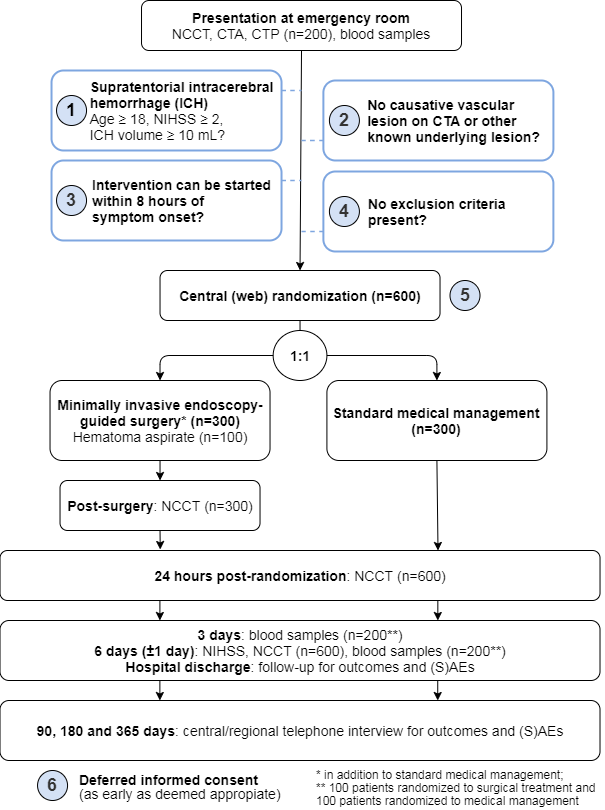
CTA: Computed tomography angiogram; CTP: CT Perfusion; ICH: intracerebral hemorrhage; NCCT: Non-contrast computed tomography; NIHSS: National Institutes of Health Stroke Scale; (S)AEs: (Serious) Adverse Events.